Statistical Methods for Complex and Dependent Data
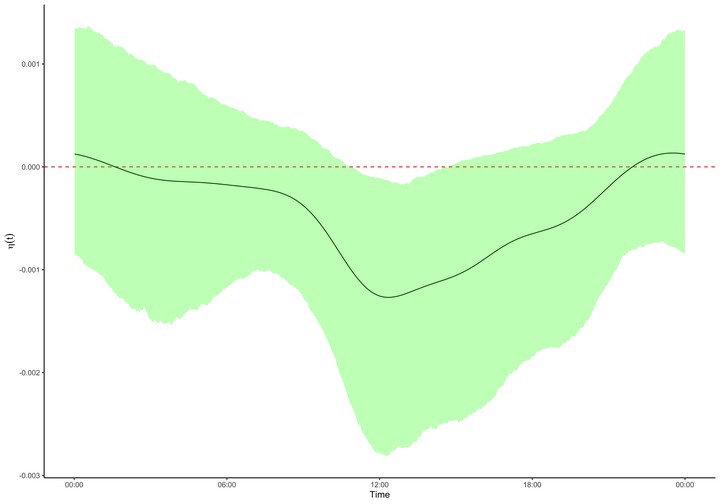
Many datasets contain observations that are not independent. Instead, the data are related because they occur across space, time, or along continuous curves. Understanding these dependencies is essential for making reliable statistical conclusions.
My research develops statistical models that capture these types of relationships while remaining computationally efficient for large datasets.
Students working on these projects learn how to build models for important types of dependent data.
Spatial Data
Spatial data arise when observations are collected at different locations in space, and nearby locations tend to have similar values. For example, environmental variables such as soil properties, temperature, or pollution often vary smoothly across geographic regions. Ignoring spatial dependence can lead to incorrect estimates and misleading uncertainty.
Temporal Data
Temporal data arise when measurements are collected over time, and values at nearby time points are correlated. Examples include economic indicators, environmental measurements, or sensor data. Modeling temporal dependence allows us to understand trends, cycles, and predict future behavior.
Functional Data
Functional data occur when each observation is itself a curve or function, rather than a single number.
Examples include:
- activity monitor curves, where a person’s physical activity is recorded continuously over the course of a day
- reflectance spectra, where measurements are recorded across wavelengths to characterize soil properties or other materials
Because these curves are measured at many points, the observations along the curve are highly correlated and must be modeled jointly.
Other Types of Structure
Many other types of structure can occur in datasets. For example text data have a natural sequential structure where words appear in series. Data may also be collected on a network, where some nodes are connected to others via edges (such as a social network). In all cases, statistical models that adequately capture the dependence structure offer immense value.
Selected publications
- Wang, Q., Parker, P.A., Lund R., and Woody, J. (2026+) A Spatio-Temporal Study of Planetary Snow Presence Trends.
- Veum, K.S., Parker, P.A., Holan, S.H., Pais, N., Wills, S.A., Amsili, J.P., van Es, H.M., Nunes, M.R., Seybold, C.A., and Karlen, D.L. (2025) Spatially Explicit Heteroskedastic Modeling for the Soil Health Assessment Protocol and Evaluation (SHAPE) version 1.0S. Soil Science Society of America Journal, 89(3), e70065.
- Parker, P.A. and Sansó, B. (2025) A Heterogeneous Spatial Model for Soil Carbon Mapping of the Contiguous United States Using VNIR Spectra. Journal of Agricultural, Biological and Environmental Statistics, Special Issue on ``New Perspectives in Statistics, Data Science and Econometrics for Agriculture, Land Use and Forestry”, 30(2), 517-539.
- Veum, K.S., Parker, P.A., Sudduth, K.A., and Holan, S.H., (2018) Predicting Profile Soil Properties with Reflectance Spectra via Bayesian Covariate Assisted External Parameter Orthogonalization. Sensors, 18, 3869, doi:10.3390/s18113869.
- Pais, N.V., Holan, S.H., Parker, P.A. (2025) Topic Modeling for Free-Response Text Data from a Complex Survey. Journal of the Royal Statistical Society Series A, 00, 1-15, https://doi.org/10.1093/jrsssa/qnaf187.
- Wang, Q., Parker, P.A., and Lund R. (2025) Hierarchical Count Echo State Network Models with Application to Graduate Student Enrollments. Data Science in Science, Special Issue on ``Data Science in the Federal Government”, 4(1), https://doi.org/10.1080/26941899.2025.2565243.
- Parker, P.A., and Holan, S.H. (2022) A Bayesian Functional Data Model for Surveys Collected under Informative Sampling with Application to Mortality Estimation using NHANES. Biometrics, 79(2), 1397-1408.
- Parker, P.A., Holan, S.H., and Wills, S.A. (2021) A General Bayesian Model for Heteroskedastic Data with Fully Conjugate Full-Conditional Distributions. Journal of Statistical Computation and Simulation, 91(15), 3207-3227.

Paul A. Parker
Assistant Professor
My research interests include Bayesian methods, especially when applied to dependent data scenarios, often using survey data.