Measuring Social and Economic Change
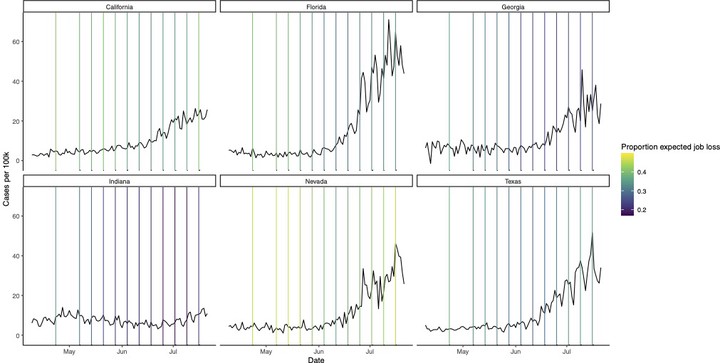
One of my main areas of research uses large federal survey datasets to study migration, inequality, and demographic change.
Government surveys like the American Community Survey collect enormous amounts of information about how people live, work, and move across the country. These data power research in sociology, economics, and public policy, but they are statistically challenging to analyze correctly. My research develops statistical methods that allow researchers to use these surveys to answer questions such as:
- How are migration patterns changing across the United States?
- How do economic conditions vary across communities?
- How can we measure inequality using noisy survey data?
Students working in this area may collaborate with social scientists and develop statistical tools for analyzing some of the largest public datasets in the world.
Selected publications
- Parker, P.A., Holan, S.H., Bachmeier, J.D., and Altman, C. (2025) The Link Between Health Insurance Coverage and Citizenship Among Immigrants: Bayesian Unit-Level Regression Modeling of Categorical Survey Data Observed with Measurement Error. Journal of the Royal Statistical Society Series A, qnaf132.
- Vedensky, D., Parker, P.A., and Holan, S.H. (2025) Bayesian Unit-level Models for Longitudinal Survey Data under Informative Sampling: An Analysis of Expected Job Loss Using the Household Pulse Survey. Journal of the Royal Statistical Society Series A, qnaf043.
- Parker, P.A., Holan, S.H., and Janicki, R. (2022) Computationally Efficient Bayesian Unit-Level Models for Non-Gaussian Data Under Informative Sampling with Application to Estimation of Health Insurance Coverage. The Annals of Applied Statistics, 16(2), 887-904.

Paul A. Parker
Assistant Professor
My research interests include Bayesian methods, especially when applied to dependent data scenarios, often using survey data.